The MoonBoard is one of the most iconic and widely used training tools in modern climbing. Combining a standardized hold layout with a global app-driven problem database and LED feedback, it lets climbers anywhere in the world train on the exact same problems and benchmark their progress against a worldwide community.
Whether you're chasing your first V5 or grinding through double-digit boulder problems, understanding how the MoonBoard works, which angles and hold sets to choose, and how to structure your sessions will help you get the most out of this powerful training board.
What is the MoonBoard?
The MoonBoard is a standardized climbing wall designed by British climbing legend Ben Moon. It consists of a fixed grid of holds arranged in a precise, replicable pattern, mounted at a set angle. Because every MoonBoard shares the same hold positions, a problem set in one gym can be climbed identically in another anywhere in the world.
The system pairs with the MoonBoard app, which stores thousands of community-created problems, each graded and rateable by users. Many MoonBoards also feature an LED system that illuminates the holds for a selected problem, so you always know exactly which holds are "in".
This combination of standardization, a vast problem library, and instant LED feedback makes the MoonBoard a uniquely powerful tool for tracking progress and training finger strength and power.
MoonBoard angles: 25° vs 40°
The MoonBoard comes in two main angle configurations, each offering a distinct training stimulus.
The 25° MoonBoard is the more accessible option. The shallower overhang places slightly less demand on raw power and finger strength, making it better suited to intermediate climbers or those building a base. It still demands precise footwork and body tension.
The 40° MoonBoard is the classic, more demanding setup. This steep overhang places enormous emphasis on finger strength, core tension, and explosive power. Problems here feel significantly harder grade-for-grade and are favored by stronger climbers looking to build maximum power.
Choosing between them depends on your current level and goals. Many climbers start on the 25° and progress to the 40° as their strength develops.
Hold sets explained
Over the years, several official MoonBoard hold sets have been released, each with its own character.
The Original School Holds (2016 and earlier) are known for aggressive, often skin-unfriendly grips that reward raw strength. The 2017 Hold Set introduced more varied, ergonomic shapes including wooden holds, making problems more technical and slightly kinder on the skin.
The 2019 Hold Set and subsequent additions like Hold Set B further expanded the variety, offering more diverse hold types and movement styles. Each set corresponds to its own bank of problems in the app, so the holds you mount determine which problems you can climb.
When setting up or training on a MoonBoard, it's essential to match your hold set to the problems you select in the app, since a problem designed for one set won't make sense on another.
Using the MoonBoard app
The MoonBoard app is the brain of the system. It lets you browse the enormous problem database, filter by grade, angle, hold set, and benchmark status, and log your attempts and sends.
Benchmarks are a special category of problems vetted by the community for accurate grading. Using benchmarks to test yourself gives a reliable measure of your level and progress over time, since their grades are more trustworthy than unvetted user submissions.
The app also tracks your session history and logbook, letting you monitor your progression, revisit projects, and avoid junk volume by focusing on quality attempts. For climbers with an LED-equipped board, the app communicates directly with the lights to display your chosen problem.
Take your training anywhere
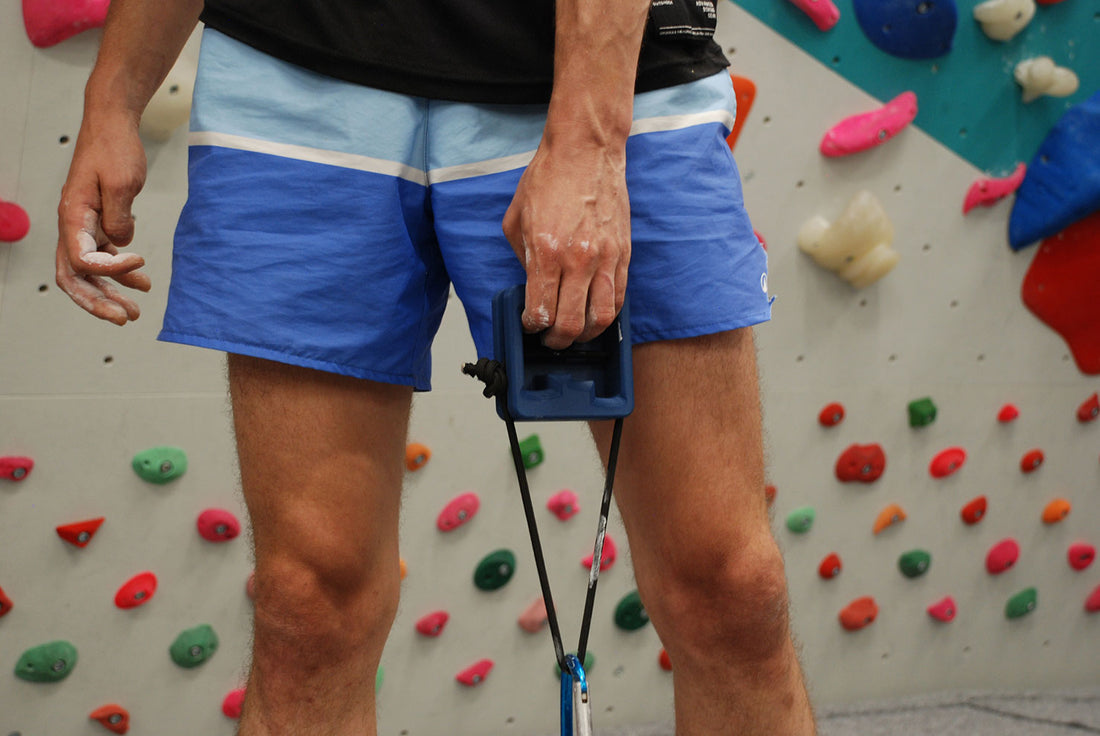
Not everyone has constant access to a MoonBoard, and finger strength gains are quickly lost without consistent stimulus. This is where a portable hangboard becomes invaluable, letting you maintain and build finger strength between board sessions, while traveling, or as a structured warm-up before you get on the wall.

The Unlevel Edge portable hangboard is designed for exactly this: ergonomic edges for progressive loading, compact enough to take anywhere, and built to complement your MoonBoard training so your fingers stay strong no matter where you are.
Structuring MoonBoard sessions
To get the most from the MoonBoard, structure your sessions around clear objectives rather than randomly pulling on problems.
For power and limit strength, select a handful of problems at or near your maximum grade. Give each 3 to 5 quality attempts with full rest (2 to 4 minutes) between tries, focusing on precise movement and full commitment.
For power-endurance, link easier problems together or repeat circuits with short rests, building your ability to sustain hard moves under fatigue.
Always begin with a thorough warm-up: raise your pulse, mobilize your shoulders and fingers, then climb progressively harder easy problems before attempting anything near your limit. The steep angle of the MoonBoard makes warming up essential for injury prevention.
Grading and progression on the MoonBoard
MoonBoard grades are known for being stiff, meaning a MoonBoard V6 often feels harder than a V6 at your local gym or outdoors. This is partly due to the steep angle and powerful style, and partly a cultural quirk of the platform.
Don't be discouraged if you climb several grades lower on the MoonBoard than elsewhere; this is completely normal. Instead, use the board's consistency to track your own progress over time. Re-testing the same benchmarks every few weeks gives you an objective measure of improvement.
Focus on gradual progression, logging your sends, and trusting that the strength you build on this demanding tool will translate directly to harder climbing everywhere else.
Conclusion
The MoonBoard is a uniquely powerful training tool that combines global standardization, a vast problem database, and instant feedback to help climbers build serious finger strength and power. By understanding the angles, hold sets, and app features, and by structuring your sessions with clear goals and proper warm-ups, you can harness this tool to break through plateaus.
Pair your board sessions with consistent finger training, respect the demands of the steep angle, and track your progress through benchmarks. The MoonBoard rewards patience and consistency, and the strength you build there will pay off across every style of climbing.
FAQ
What angle should I choose for my MoonBoard?
Choose the 25° MoonBoard if you're an intermediate climber or building a strength base, since it's slightly more forgiving while still demanding good technique. Opt for the 40° MoonBoard if you're a stronger climber seeking maximum power development. Many climbers progress from 25° to 40° as their finger strength and core tension improve.
Why do MoonBoard grades feel so hard?
MoonBoard grades are deliberately stiff due to the steep overhang and powerful, finger-intensive style. A MoonBoard V6 commonly feels harder than a V6 at a gym or outdoors. This is normal and expected, so focus on your own progression over time rather than comparing MoonBoard grades to other settings.
How often should I train on the MoonBoard?
Most climbers benefit from 1 to 2 MoonBoard sessions per week, allowing 48 to 72 hours of recovery between hard finger-intensive days. The steep angle places significant stress on fingers and tendons, so adequate rest and a gradual progression are essential to avoid injury.
Do I need the LED system to use a MoonBoard?
No, the LED system is optional but highly convenient. Without LEDs, you simply reference the problem in the app and identify the holds manually by their grid coordinates. The LED system speeds up sessions by automatically illuminating the holds for your selected problem, reducing setup time between attempts.

Stiff grades demand serious finger strength. Build it between sessions on a board you can take anywhere.
From €65
Shop the board →