
If you're a climber looking to break through plateaus and reach new heights, a well-structured climbing training plan is your roadmap to success. Climbing demands a unique blend of strength, power, and endurance, and developing all three systematically is what separates climbers who steadily improve from those who stagnate.
This comprehensive guide breaks down how to build a complete climbing training plan, covering the key physical qualities you need, how to structure your weeks and training blocks, and the specific protocols that develop finger strength, power, and endurance safely and effectively.
The physical qualities climbing demands

Climbing performance rests on several interconnected physical qualities. Understanding each one helps you target your weaknesses and build a balanced training plan.
Finger strength is arguably the most climbing-specific quality. Your ability to grip small holds and maintain tension on tiny edges directly determines the difficulty of routes you can climb. Power refers to your ability to generate force quickly, essential for dynamic moves, deadpoints, and explosive sequences.
Power-endurance bridges the gap between pure power and aerobic endurance, allowing you to sustain hard moves over a series of efforts. Finally, aerobic endurance supports recovery between hard sections and enables you to climb for longer without fatigue. Add to these core strength, body tension, and flexibility, and you have the full picture of climbing fitness.
Assessing your current level
Before diving into a training plan, honestly assess where you stand. Knowing your strengths and weaknesses lets you allocate training time where it matters most.
Consider testing your max hang on a standardized edge (such as a 20mm edge), your max pull-up count, and your repeater performance to gauge power-endurance. Track the grades you climb consistently versus your absolute limit. A climber who flashes V5 but projects V6 has different needs than one who slowly works through every V4.
Use these benchmarks to identify whether you're strength-limited, endurance-limited, or technique-limited, and structure your plan accordingly.
Structuring your training week

A balanced training week distributes stress and recovery intelligently. The key principle is to schedule your most demanding finger and power work when you're freshest, and to allow adequate recovery between hard sessions.
A typical intermediate week might include two climbing-focused sessions, one dedicated finger strength session, and one endurance or volume session, with rest days strategically placed. Avoid stacking hard finger days back-to-back, as your tendons and pulleys need 48 to 72 hours to recover fully.
Listen to your body and adjust. Fatigue, persistent soreness, or declining performance are signals to add rest rather than push through.
Periodization: training in blocks
Periodization organizes your training into focused blocks, each emphasizing a specific quality. This approach prevents plateaus and allows you to peak for important climbing trips or projects.
A common structure follows this progression: a strength block (4 to 6 weeks) focusing on max finger strength and power, followed by a power-endurance block (3 to 4 weeks) developing your ability to sustain hard moves, and finally a performance phase where you apply your gains to real climbing projects.
Between blocks, schedule a deload week with reduced volume and intensity to allow supercompensation. This is when your body adapts and gets stronger.
Finger strength protocols

Finger strength is best developed through hangboard training. The two most effective protocols are max hangs and repeaters.
Max hangs build maximum strength. Perform 5 to 10 second hangs at high intensity (RPE 8 to 9), resting 2 to 3 minutes between efforts. Aim for 3 to 5 hangs per grip type, focusing on 1 to 2 grips per session.
Repeaters develop strength-endurance. A classic protocol is 7 seconds on, 3 seconds off, repeated 6 times per set, for 3 to 5 sets. Rest 2 to 3 minutes between sets.
Always warm up thoroughly before any finger-intensive work, and stop immediately if you feel sharp pain in your fingers or tendons.
Power development
Power training teaches your body to generate force explosively. The most effective methods include limit bouldering, campus board training, and dynamic movement drills.
Limit bouldering involves working near-maximal boulder problems with full rest between attempts. Choose problems at or just beyond your limit, take 3 to 5 minutes rest between tries, and focus on quality over quantity.
Campus board training is highly effective but demands a solid strength base. It involves explosive movements between rungs without using your feet. Only incorporate campus training once you have at least a year of consistent climbing and solid finger strength, as it places extreme stress on your fingers and shoulders.
Endurance and power-endurance

Endurance training builds your capacity to climb for longer and recover faster. Climbing endurance comes in two main forms: aerobic capacity and power-endurance.
For aerobic capacity, use ARC training (Aerobic Restoration and Capacity): climb continuously for 20 to 45 minutes at an easy intensity where you never pump out. This builds capillary density and improves recovery.
For power-endurance, use 4x4s: climb four boulder problems back-to-back, rest, and repeat four times. This trains your ability to sustain hard moves under fatigue. Linked circuits on a board or wall also work well, targeting the burn you feel on sustained routes.
Recovery and injury prevention
Recovery is where adaptation happens. Without adequate rest, your body cannot rebuild stronger. Prioritize sleep (aim for 7 to 9 hours), proper nutrition, and active recovery on rest days.
Injury prevention for climbers centers on antagonist training and gradual progression. Strengthen your pushing muscles (shoulders, chest, triceps) to balance all the pulling climbing demands. Include wrist and finger extensor work to protect against elbow tendinopathy. Most importantly, progress gradually: most climbing injuries come from doing too much, too soon.
Putting it all together
A complete climbing training plan integrates all these elements into a coherent structure. Start by assessing your level, identify your limiting factors, then build a periodized plan that addresses them while maintaining your strengths.
Remember that consistency beats intensity over the long term. A sustainable plan you follow for months will outperform an aggressive plan that burns you out or injures you in weeks. Track your progress, adjust based on results, and stay patient.
Conclusion
Building a complete climbing training plan for strength, power, and endurance is a journey of systematic progression. By understanding the physical qualities climbing demands, assessing your current level, and structuring your training into focused blocks, you set yourself up for steady, sustainable improvement.
Start where you are, prioritize recovery, and trust the process. Your next breakthrough is built one well-planned session at a time.
FAQ
How many days per week should I train for climbing?
Most climbers benefit from 3 to 4 sessions per week, combining climbing and supplementary training. Beginners may start with 2 to 3 sessions to allow adaptation, while advanced climbers may train 4 to 6 times with careful management of recovery. The key is matching volume to your recovery capacity and avoiding consecutive hard finger days.
When should I start hangboard training?
You should have at least 6 to 12 months of consistent climbing before beginning structured hangboard training. This allows your tendons and pulleys to adapt to climbing stress first. Starting too early increases injury risk without proportional benefit, since beginners improve fastest through climbing volume and technique.
What's the difference between power and power-endurance?
Power is your ability to generate maximal force quickly, used for single explosive moves. Power-endurance is your ability to sustain repeated hard moves before pumping out. Power training uses short efforts with full rest; power-endurance training uses longer efforts with incomplete rest to build resistance to fatigue.
How long should a training block last?
A focused training block typically lasts 3 to 6 weeks, long enough to drive adaptation but short enough to maintain motivation and avoid overtraining. Follow each block with a deload week of reduced volume and intensity to allow supercompensation before starting the next block.

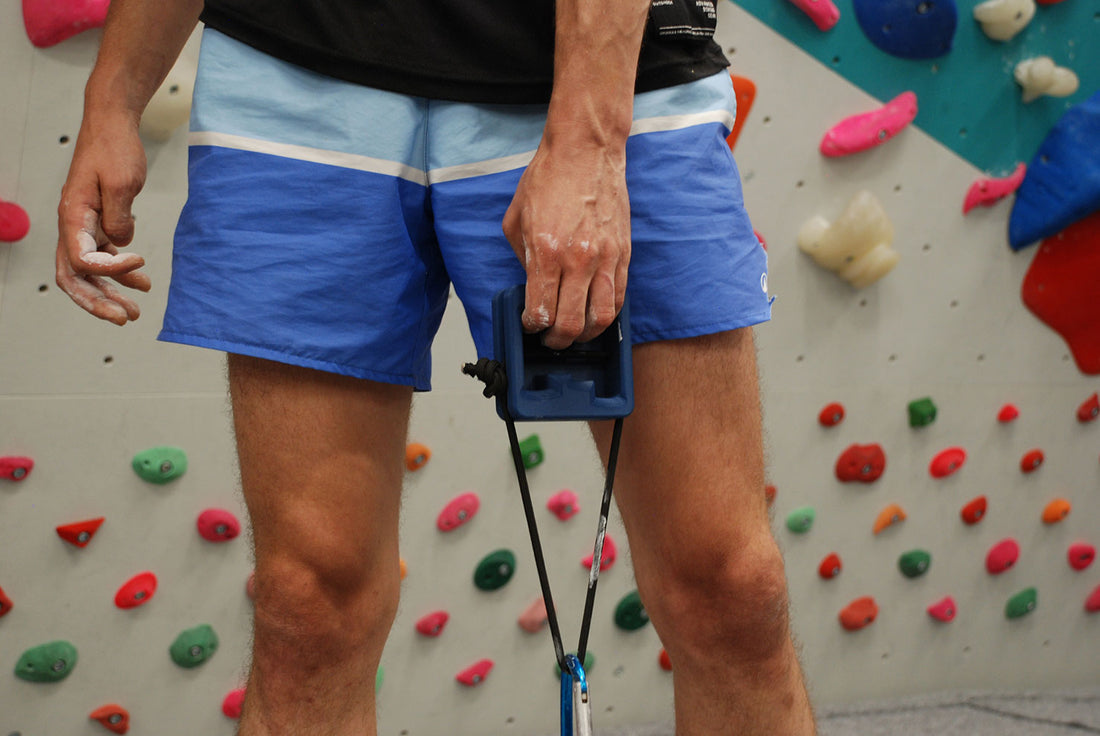
A complete plan needs a finger strength tool you can rely on. Progressive, measurable, ergonomic loading.
From €65
Shop the board →